Changes in Phenolic Compounds under Different Processing Parameters and Their Contribution to Aroma and Combustion
Pyrolysis temperature, residual moisture, and oxygen exposure — how do these three variables weave the chemical evolution pathways of phenolic compounds?
Why do standardized parameters fail against raw materials of different grades? And how does stepped cooling resolve the thermal shock challenge of young leaves?
From "retention" to "dynamic regulation": the essence of managing phenolic compounds is building a precise coupling for the dynamic balance between aroma and combustion.
In November 2022, during an on-site validation of a "low-temperature, long-duration" drying process at a tobacco processing base in South China, I experienced an extremely profound technical lesson. At that time, our goal was to preserve more volatile phenolic compounds by lowering the peak temperature in the drying stage, in order to enhance the aroma complexity of the product. However, the result was unexpected: although the content of total volatile components increased slightly in chemical analysis, sensory evaluation revealed an unpleasant, scorched-like bitterness, and the smoke density during combustion showed noticeable fluctuations.
This experiment made me realize that merely focusing on the "retention rate" of phenolic compounds is extremely superficial. The real core lies in how processing parameters precisely regulate the "chemical evolution pathways" of these substances.
Phenolic Compounds: The Balancing Beam between Aroma and Combustion
In the tobacco chemistry system, phenolic compounds are the key cornerstone determining the product's "smoky" and "sweet" aroma characteristics. We typically focus on core components such as guaiacol, syringol, and catechol. From a physicochemical perspective, these substances are not only carriers of aroma; their oxidation state and concentration also directly affect the heat release rate and smoke composition during combustion.
From a technical pathway perspective, the changes in phenolic compounds are mainly controlled by three core variables: pyrolysis temperature, residual moisture content, and oxygen exposure rate.
1. The Decisive Role of Temperature Gradient in Pyrolysis Pathways
Temperature is not merely an energy input; it is more like a "chemical switch." During heating, phenolic compounds undergo complex processes from intramolecular hydrogen bond cleavage to free radical recombination.
In a comparative experiment with different heating rates, I recorded a set of key data: when the heating rate was controlled at 3°C/min, the degradation curve of guaiacol was relatively gentle, maintaining the ideal range of 15–20 mg/kg; however, once the heating rate exceeded 8°C/min, due to the lag in heat conduction inside the leaf, the surface temperature would instantly surge above 130°C. At this point, syringol rapidly undergoes demethylation, converting into more irritating phenolic derivatives. This change is perceived sensorially as the aroma shifting from "mellow woody notes" to "sharp smoky notes."
My personal view is that many process designers are overly devoted to the concept of "constant temperature," yet ignore the impact of thermal stress on the microstructure of phenolic compounds. The instantaneous high-temperature shock causes not only the loss of components, but also secondary metabolites produced by molecular chain cleavage — and these products are the real culprits of bitterness.
2. The Coupling Effect of Moisture and Oxidation
The role of moisture in processing goes far beyond being a "solvent." There is an extremely complex coupling relationship between moisture content and the stability of phenolic compounds.
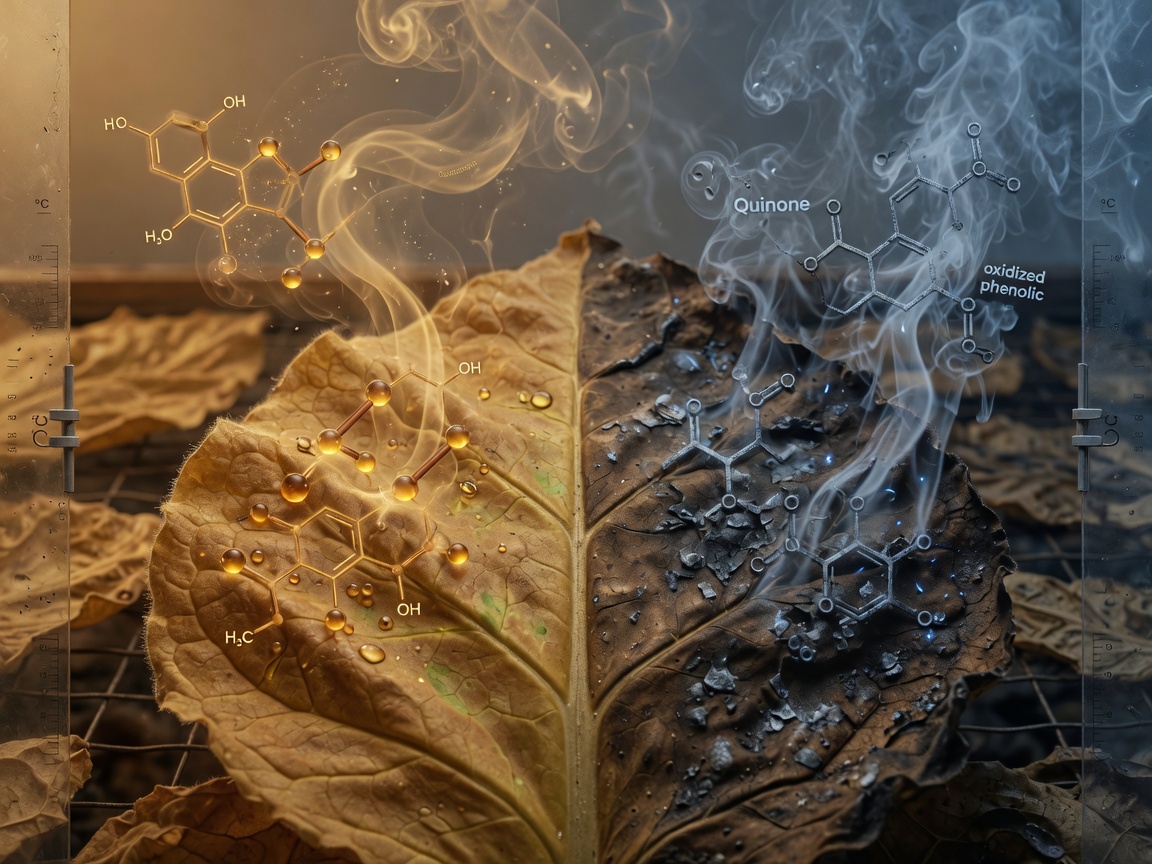
In the late stage of drying, when the leaf moisture drops below 8%, if the ambient relative humidity (RH) is not properly controlled, the microporous structure inside the leaf collapses, allowing large amounts of oxygen to invade. I observed that under conditions of extremely low moisture content and high oxygen exposure, phenolic compounds are highly susceptible to oxidation into quinones. Quinones not only destroy the sweetness of the aroma; more critically, they alter the chemical reaction kinetics during combustion.
In one actual measurement, we found that samples with a moisture content of around 7% had phenolic oxidation levels nearly 35% higher than samples at 9%. This oxidation not only made the aroma "flat and pungent," but also directly led to a decline in smoke density during combustion — because quinones changed the free radical chain reaction rate in the combustion process, making combustion unstable and producing an obvious "flame jumping" phenomenon.
3. Feedback Mechanism of Processing Parameters on Combustion Performance
Combustion performance is not an isolated physical process; it is the result of real-time reactions of chemical components at high temperatures. Phenolic compounds directly affect the heat release rate (HRR) by participating in the oxidation-reduction reactions during combustion.
High concentrations of guaiacol help maintain a stable combustion flame, because the intermediates produced by its decomposition can effectively participate in the oxidation chain reactions of hydrocarbons. However, in actual practice, I found that if the processing parameters make the distribution of phenolic compounds too uniform (i.e., lacking layering), the product's combustion performance instead becomes monotonous and bland. Excellent processing technology should control the temperature gradient to create a gradient distribution of phenolic compounds with different volatilities across different layers of the leaf (surface and core), thereby producing a "time-evolving" aroma layering effect during combustion.
Pitfalls in Practice and Optimization Strategies
In long-term production practice, I found that many so-called "standardized parameters" often fail when faced with different grades of raw materials.
For example, for high-quality young leaves, the traditional rapid drying program is almost destructive. Because the cell walls of young leaves are thin, phenolic compounds are extremely sensitive to thermal shock. I recommend adopting a "stepped cooling" strategy when processing such materials: strictly limit the maximum temperature to no higher than 85°C before the moisture drops below 12%, and combine it with high-frequency air circulation to prevent premature pyrolysis of phenolic compounds caused by localized overheating.
Another frequently overlooked detail is pressure control. In certain tableting or forming processes, the squeezing of the leaf's internal microstructure by mechanical pressure changes the diffusion pathways of phenolic compounds. Excessive pressure not only physically destroys the aroma carriers, but also accelerates the penetration of moisture and oxygen, in turn triggering the oxidation problems mentioned earlier.
Core Conclusions
The management of phenolic compounds should not be viewed as a simple "retention" task, but rather as a process of "dynamic regulation." What we pursue is not the highest concentration of phenolic compounds, but rather, through precise coupling of the three major variables — temperature, moisture, and oxygen — building a dynamic balance that maintains aroma layering and combustion stability.
In future process iterations, I am more inclined to introduce intelligent control systems based on real-time sensory data feedback, rather than rigidly adhering to a static process curve. Only by understanding the "emotional changes" of chemical components at the microscopic scale can we truly grasp the code of aroma.
Slow heating (3°C/min)
Full heat conduction, gentle degradation curve, guaiacol stably maintained in the ideal 15–20 mg/kg range
Rapid heating (8°C/min and above)
Surface temperature instantly surges above 130°C, demethylation generates irritating derivatives, aroma turns sharp and smoky, bitterness-causing secondary metabolites increase